International Finance
Session 3 — Securities Markets: Money Markets and Bonds
Laura Contreras-Portela
KEDGE Business School
October 2026
A small open economy, in two equations
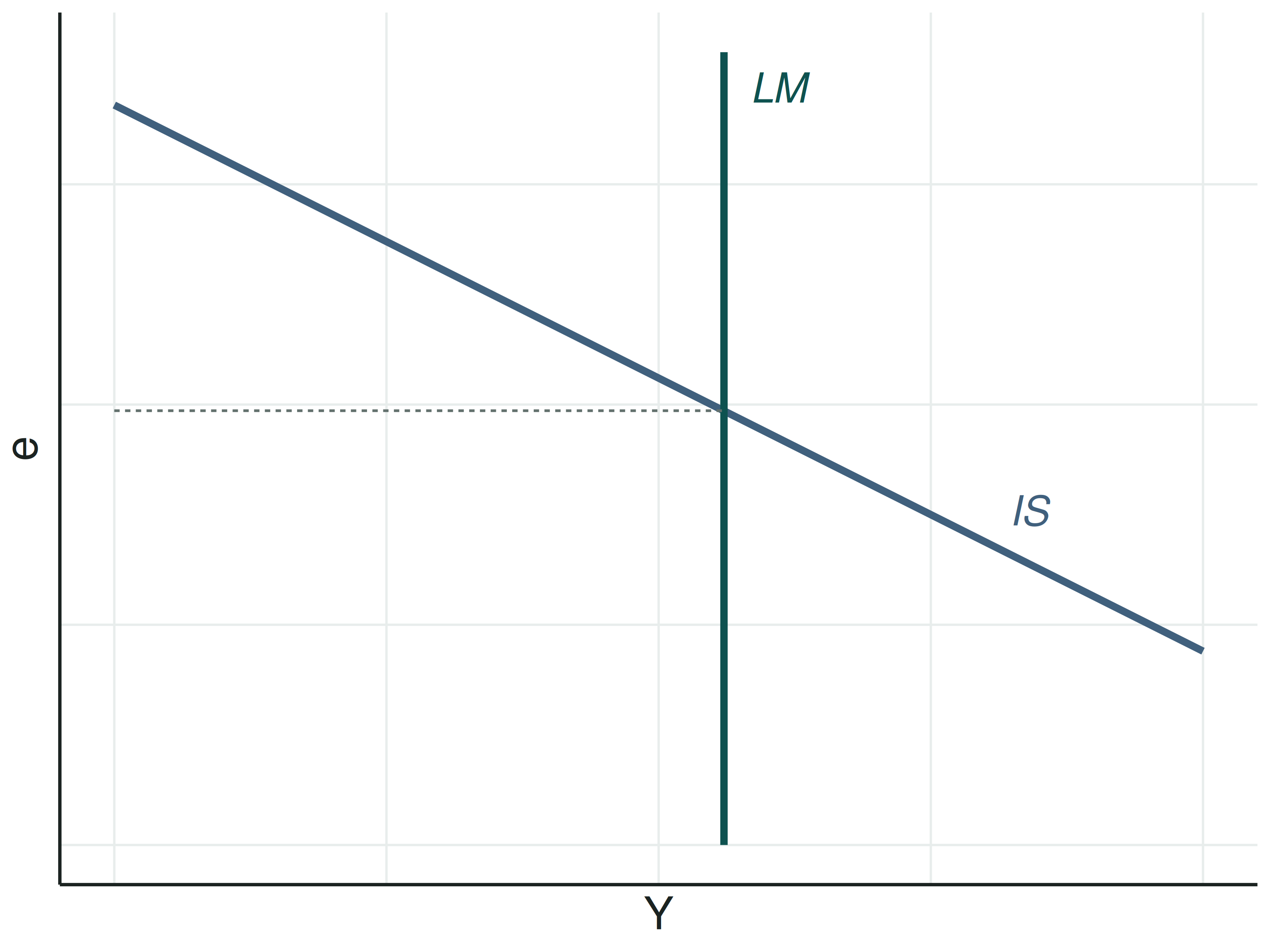
Every market we open today sits inside one framework. A small open economy with perfect capital mobility, so the domestic rate is pinned to the world rate: i = i^{*}.
IS — the goods market, for a given i^{*}:
Y = C(Y-T) + I(i^{*}) + G + NX(e)
LM — the money market, for a given i^{*}:
M/P = L(i^{*}, Y)
The LM curve comes out vertical in (Y, e) space. Why?
e = foreign currency per unit of domestic currency.
What the model predicts
Fill it in. A fiscal expansion, a monetary expansion, an import restriction — what does each do to the exchange rate and to output, under floating and under fixed rates?
| Policy | Floating: e | Floating: Y | Fixed: e | Fixed: Y |
|---|---|---|---|---|
| Fiscal expansion | ||||
| Monetary expansion | ||||
| Import restriction |
Press C and draw the IS and LM shift for each row before writing the sign.
The fixed-rate row, in one country
Thailand, 1997. The baht was fixed at $0.04 while the equilibrium rate had fallen to $0.02.
- To hold the rate the central bank must buy 300 million baht a month, paying in dollars from its reserves.
- That is the fixed-rate row of the table, happening: every intervention contracts the domestic money supply. Monetary policy is not available.
- When the reserves run out the choice is to float or to devalue. In July 1997 Thailand floated, and the baht halved overnight.
Axes: millions of baht per month horizontal, dollars per baht vertical.
Where we are
Sessions 1 and 2 established four prices and the balance-of-payments identity. We now disaggregate the financial system by instrument, and ask how each market transfers funds from surplus units to deficit units.
- Money markets — short-term debt instruments
- Bond markets — long-term debt instruments
- Stock markets — ownership claims in firms
- Mortgage markets — loans secured by real estate
- Foreign exchange markets — trading of currencies
- Derivatives markets — contracts whose value depends on an underlying asset
Each market is analysed through the same two questions: what contractual claim does the instrument represent, and what determines its price. These are the organising questions of the course, and of the examination.
Plus the reading discussion: Sartzetakis (2021) on green bonds.
9 August 2007: a funding market stops
BNP Paribas suspended redemptions from three investment funds after liquidity disappeared from parts of the market for mortgage-related securities.
- Financial institutions often borrow short-term to finance longer-term assets. This is known as maturity transformation.
- When short-term debt matures, institutions must repay it or obtain new funding. Much of this short-term funding is obtained in money markets.
- This creates rollover risk: the risk that new funding is unavailable when existing debt matures.
- In 2007, access to short-term funding became increasingly difficult. Similar funding pressures later affected Northern Rock, Bear Stearns, and Lehman Brothers.
Why can a disruption in short-term funding threaten the stability of a financial institution?*
1 · Money markets
The corporate cash-timing problem
A firm receives EUR 40 million on the 25th of the month and disburses it on the 5th. For eleven days those funds must earn a return without being committed: the firm requires a liquid, short-dated, low-risk store of value.
- Receipts and disbursements are imperfectly synchronised — for corporations, for banks, and for governments alike.
- The money market exists to price that mismatch. It is a market for liquidity over short horizons, not for long-run investment returns.
1 · What makes a money market instrument
- Short maturity — under one year, and typically under 120 days. This limits both interest-rate risk and the horizon over which credit quality can deteriorate.
- High liquidity — the instrument can be sold before maturity without a material price concession.
- Low default risk — issuers are sovereigns, large banks and highly rated corporations.
- Large denominations — USD 1 million and above. This is a wholesale market; households participate indirectly, through money market funds.
The four properties are not independent. Short maturity makes low default risk credible; low default risk and standardisation are what sustain a liquid secondary market. Both parties are managing a liquidity-timing problem rather than seeking a risk-adjusted return — which is why these instruments price close to the risk-free curve, and why small deviations from it are informative.
1 · The instruments
- Zero-coupon obligations of the U.S. Treasury, 28 days to 12 months.
- Issued by auction. Competitive bids specify a price and may be rationed; noncompetitive bids accept the clearing price and are filled in full.
- They constitute the benchmark risk-free asset of the domestic market: every other short rate in this session is quoted relative to them.
- Uncollateralised loans of reserve balances between depository institutions, predominantly overnight.
- Banks use them to satisfy reserve requirements at the close of the maintenance period.
- The federal funds rate is the operating target of U.S. monetary policy, which makes it the anchor of the short end of the yield curve.
- A repurchase agreement is the sale of a security with a simultaneous commitment to repurchase it at a fixed price, typically within 3 to 14 days.
- Economically it is a collateralised loan; the repurchase price less the sale price is the interest. Legally it is a sale, which is why repo receives privileged treatment in bankruptcy.
- The lender applies a haircut — lending less than the collateral’s market value — as protection against a fall in that value.
- Unlike fed funds, non-bank institutions participate, which is what made the repo market both large and, in 2008, a channel for runs.
- Negotiable certificates of deposit: bank-issued time deposits, USD 100,000 to USD 10 million, transferable before maturity.
- Commercial paper: an unsecured promissory note issued by a corporation. Maturity is capped at 270 days because that is the limit of the exemption from SEC registration.
- Being unsecured, commercial paper is a direct claim on the issuer’s creditworthiness — the feature that matters in section 1’s charts.
- A banker’s acceptance is a time draft on which a commercial bank has substituted its own credit for the importer’s.
- This resolves a problem of asymmetric information in cross-border trade: the exporter is paid at once, bears no exchange-rate exposure, and need not evaluate a counterparty it cannot observe. The importer’s bank, which can observe it, performs that assessment.
- Eurodollars are dollar-denominated deposits held at banks outside the United States — a response to the dollar’s role as invoicing and settlement currency, not to any feature of U.S. regulation alone.
1 · The instruments side by side
| Instrument | Issuer | Buyer | Usual maturity | Secondary market |
|---|---|---|---|---|
| Treasury bills | U.S. government | Consumers and companies | 4, 13, 26 weeks | Excellent |
| Federal funds | Banks | Banks | 1 to 7 days | None |
| Repurchase agreements | Businesses and banks | Businesses and banks | 1 to 15 days | Good |
| Negotiable CDs | Large money-centre banks | Businesses | 14 to 120 days | Good |
| Commercial paper | Finance companies and businesses | Businesses | 1 to 270 days | Poor |
| Banker’s acceptance | Banks | Businesses | 30 to 180 days | Good |
| Eurodollar deposits | Non-US banks | Businesses, governments, banks | 1 day to 1 year | Poor |
The final column is a ranking of secondary-market liquidity. Adapted from Mishkin, F.S. and Eakins, S.G., Financial Markets and Institutions.
1 · The rates move together
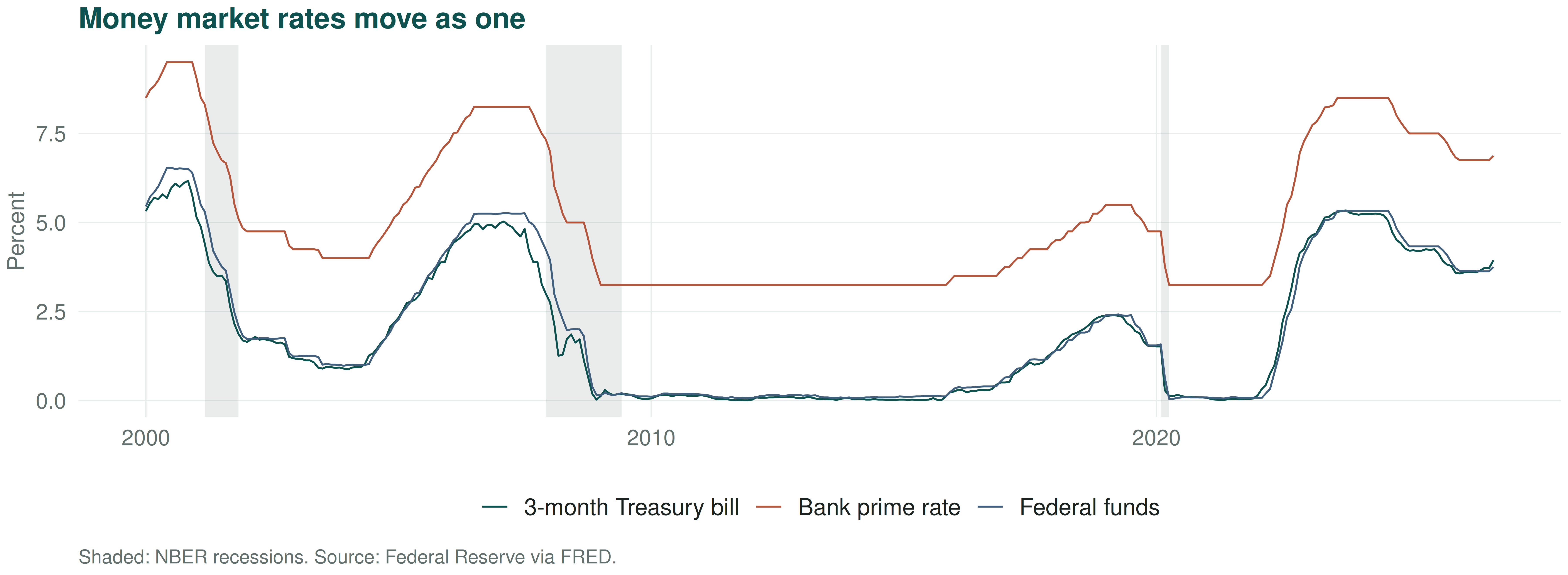
The series co-move closely because they share a common policy anchor. Under what conditions does the spread between the federal funds rate and the Treasury bill rate widen, and what is that spread measuring?
1 · Commercial paper outstanding
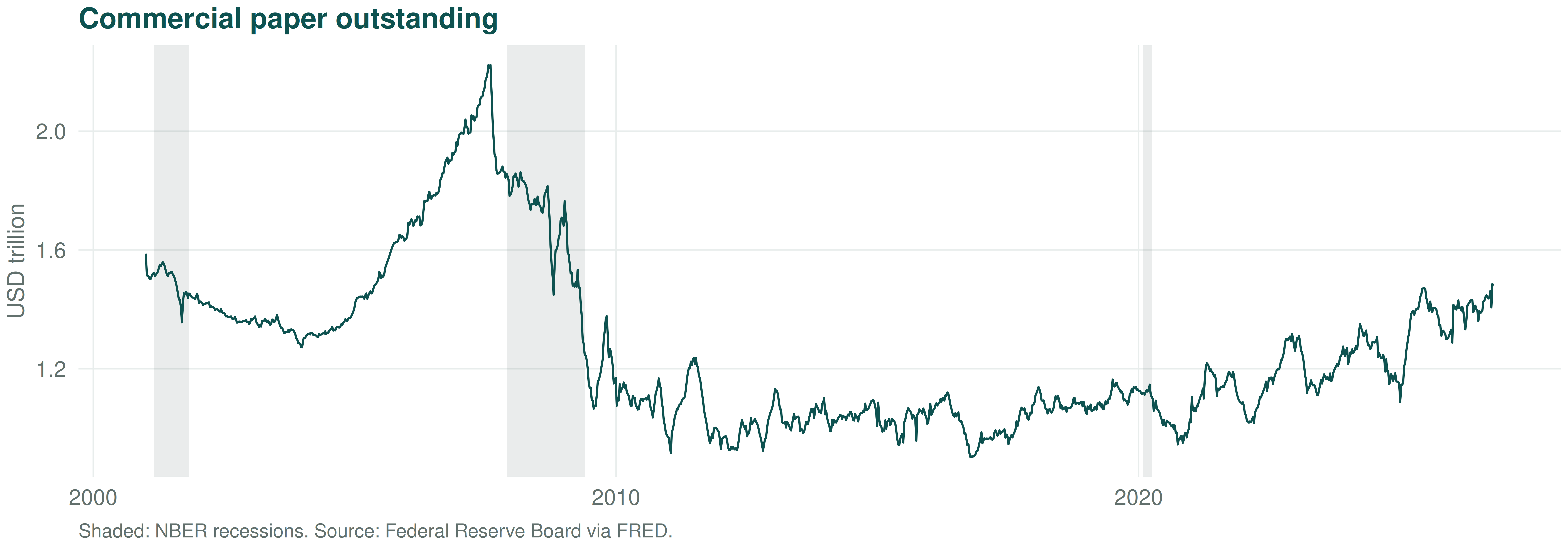
2007 marks a structural break, not a cyclical decline: the series steps down and does not recover its prior level. Which class of issuer exited the market, why could it not return, and what replaced that funding?
1 · Price and rate
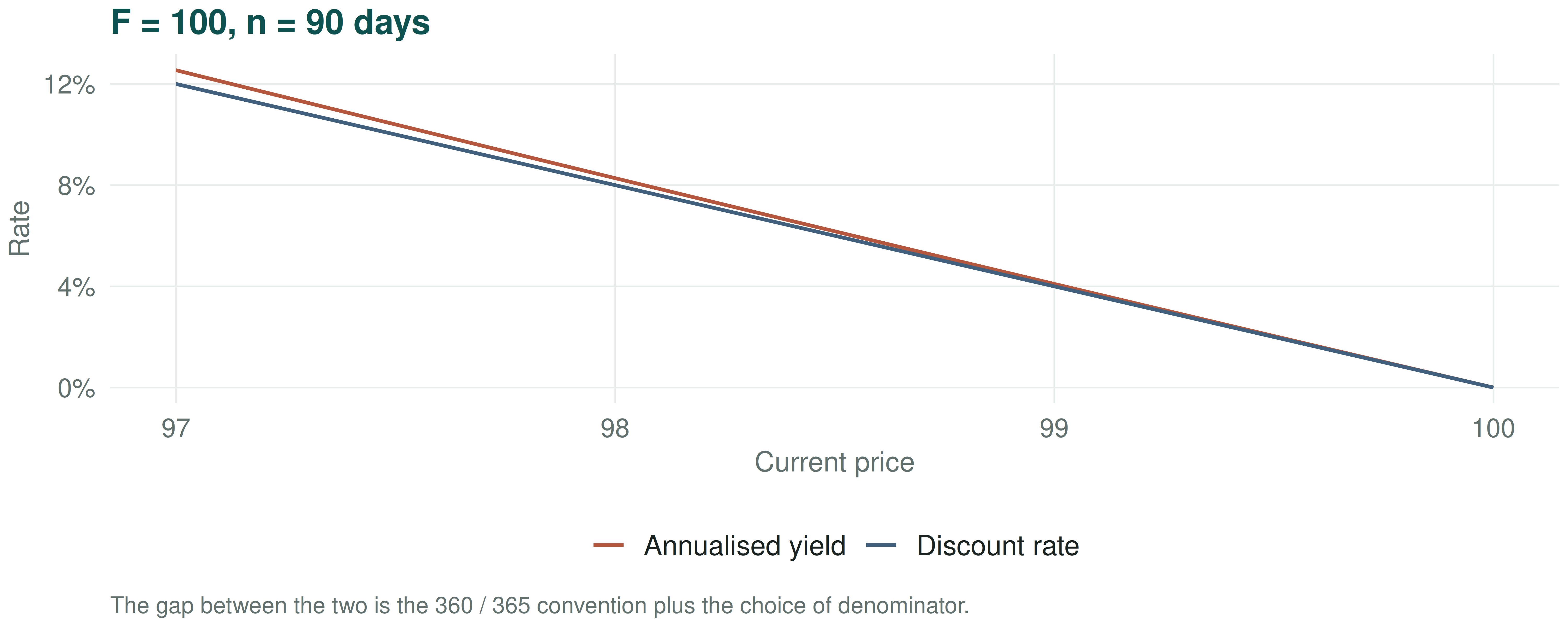
Money market instruments are zero-coupon: they are purchased below face value and redeemed at face value, so the entire return is the discount. Two conventions are used to express it, and they are not interchangeable.
The discount rate — how far below face value you paid:
i_{discount} = \frac{F-P}{F} \times \frac{360}{n}
The annualised yield — what you actually earned:
i_{yt} = \frac{F-P}{P} \times \frac{365}{n}
One instrument, two measures. The bank discount basis deflates by face value F on a 360-day year — a convention inherited from pre-computational market practice. The annualised yield deflates by the price actually paid, P, on a 365-day year, and is therefore the true holding-period return expressed annually. Since P < F, the yield always exceeds the discount rate. Only the yield is comparable across instruments.
1 · The two rates, drawn
1 · Problem 2.1
A 28-day T-bill costs $996.73 and is worth $1,000 at maturity.
- What is the discount rate?
- What is the annualised yield?
1 · Problem 2.2
The Treasury auctions $2.5 billion of 91-day bills. Competitive bids:
| Bidder | Bid amount | Bid price |
|---|---|---|
| 1 | $500 million | $0.9940 |
| 2 | $750 million | $0.9901 |
| 3 | $1.5 billion | $0.9925 |
| 4 | $1 billion | $0.9936 |
| 5 | $600 million | $0.9939 |
It also received $750 million of noncompetitive bids.
Who receives bills, how many, and at what price?
2 · The bond market
Athens, March 2012
In March 2012, Greece restructured around €200 billion of government debt. Private investors accepted losses of roughly 53% of face value. Only a few years earlier, Greek government bonds had been rated investment grade.
- A bond is a contract: the issuer promises specific payments on specific dates.
- But promised payments are not guaranteed. The issuer may be unable or unwilling to pay.
- This possibility is credit risk — and investors require compensation for bearing it.
- Sovereign bonds have an additional complication: enforcing claims against a government can be particularly difficult.
2 · The vocabulary
| Term | What it means |
|---|---|
| Coupon interest rate | The annual interest rate, usually fixed for the whole life |
| Current yield | Coupon payment divided by the current price |
| Face amount / par value | The maturity value |
| Indenture | The contract that specifies the terms of the loan agreement |
| Market rate | The rate currently in effect on securities of like risk and maturity |
| Maturity | Number of periods until the security matures |
| Yield to maturity | The yield if you buy at the current price and hold to maturity |
The coupon rate is fixed in the indenture at issue. The market rate on comparable risk and maturity varies continuously. If the contractual payments cannot adjust, the only variable that can reconcile the two is the price. The whole of bond valuation follows from that single observation.
2 · The instruments
- Treasury notes: 1 to 10 years. Treasury bonds: 10 to 30 years.
- Nominal default risk is negligible because the obligation is denominated in a currency the issuer creates. That is a statement about nominal default only.
- Two risks remain and are examinable: inflation risk, which erodes the real value of fixed payments, and interest-rate risk, the capital loss on an existing bond when market rates rise. The latter increases with maturity.
Issued by local, county and state governments to fund public projects.
Tax free, which is the whole point. Compare like with like:
\text{after-tax rate} = \text{taxable rate}\times(1-\text{marginal tax rate})
General obligation bonds are repaid from taxes; revenue bonds from user fees on the project itself.
They are not default free. Detroit, 2013.
- Face value usually USD 1,000, interest paid semi-annually.
- Restrictive covenants limit dividends, new debt, ratios — they exist because shareholder and bondholder interests conflict.
- A call provision lets the issuer buy the bond back. A conversion feature lets the holder turn it into equity.
- Secured bondholders have first claim on a specific asset; unsecured ones do not, and charge more for it.
- Agencies map credit risk onto an ordinal scale from Aaa/AAA downwards. Below Baa3/BBB- an issue is speculative grade.
- That threshold has effects beyond information. Many institutional mandates — insurers, pension funds, some trusts — prohibit holdings below it, so a one-notch downgrade can compel sales by investors with no independent view of the credit.
- The result is forced selling into a falling market: a price movement caused by mandate design rather than by fundamentals.
- Note also the issuer-pays model: the entity being rated selects and remunerates the agency. The conflict of interest this creates is central to the post-2008 literature on structured credit.
2 · The rating scales
| Moody’s | S&P | Fitch | Meaning |
|---|---|---|---|
| Aaa | AAA | AAA | Best quality, least credit risk |
| Aa1-Aa3 | AA+/AA/AA- | AA+/AA/AA- | High quality, very strong capacity |
| A1-A3 | A+/A/A- | A+/A/A- | Upper-medium grade |
| Baa1-Baa3 | BBB+/BBB/BBB- | BBB+/BBB/BBB- | Medium quality, adequate capacity |
| Moody’s | S&P | Fitch | Meaning |
|---|---|---|---|
| Ba1-Ba3 | BB+/BB/BB- | BB+/BB/BB- | Speculative |
| B1-B3 | B+/B/B- | B+/B/B- | Very speculative |
| Caa-C | CCC/CC/C | CCC/CC/C | Highly speculative, near or in default |
| — | D | DDD/DD/D | In default |
A bond is downgraded just one step, from BBB− to BB+. The change in credit risk may be small. But BB+ is no longer investment grade.
Why might this small downgrade cause a large fall in the bond’s price?
2 · Rates by credit quality
Credit ratings summarize differences in credit risk.
If investors think a bond is more likely to default, they will only hold it if it offers a higher yield.
[ ]
So how large is this difference in practice?
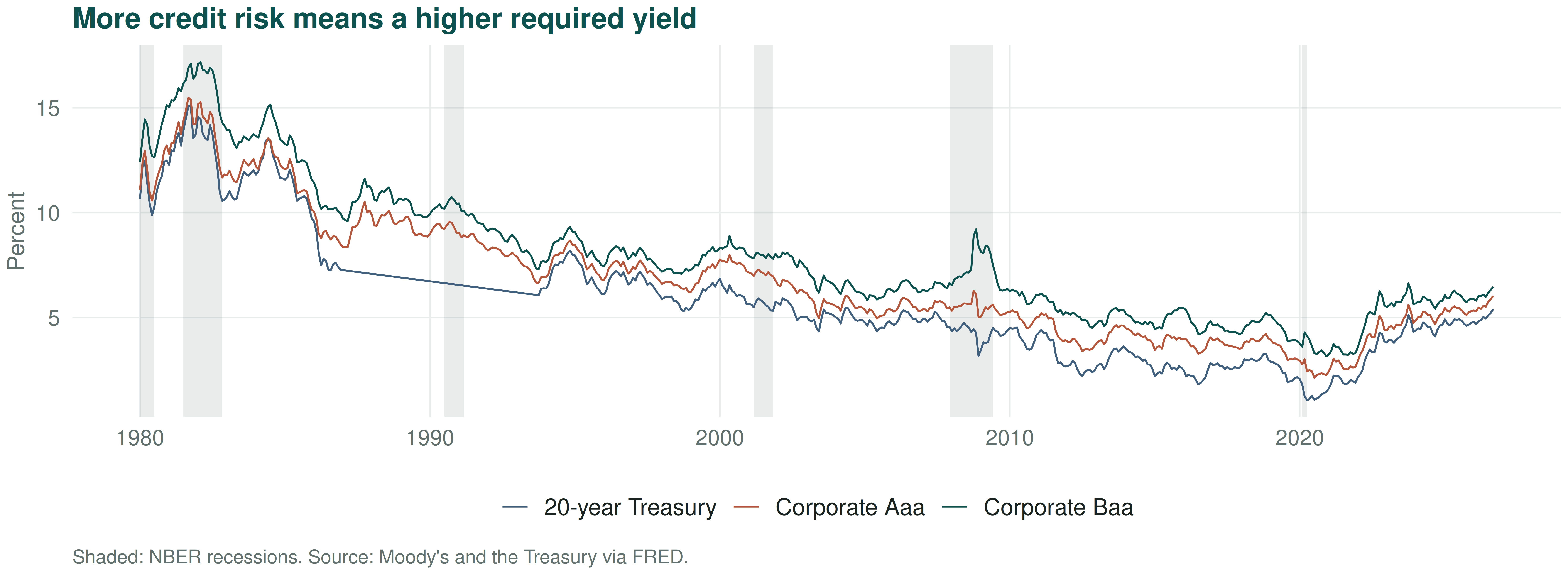
Why does the gap between corporate and Treasury yields become much larger during recessions?
2 · The price of a bond
A bond is worth today the present value of the payments it promises in the future.
For a bond paying coupon C each year and face value F at maturity:
P = \frac{C}{1+r} + \frac{C}{(1+r)^2} + \dots + \frac{C+F}{(1+r)^n}
where r is the return investors currently require for a bond with similar risk and maturity.
When the required yield rises, the bond price falls:
r \uparrow \quad \Longrightarrow \quad P \downarrow
The bond’s promised payments have not changed. What changes is the price investors are willing to pay for them today.
2 · Two ways of quoting the return
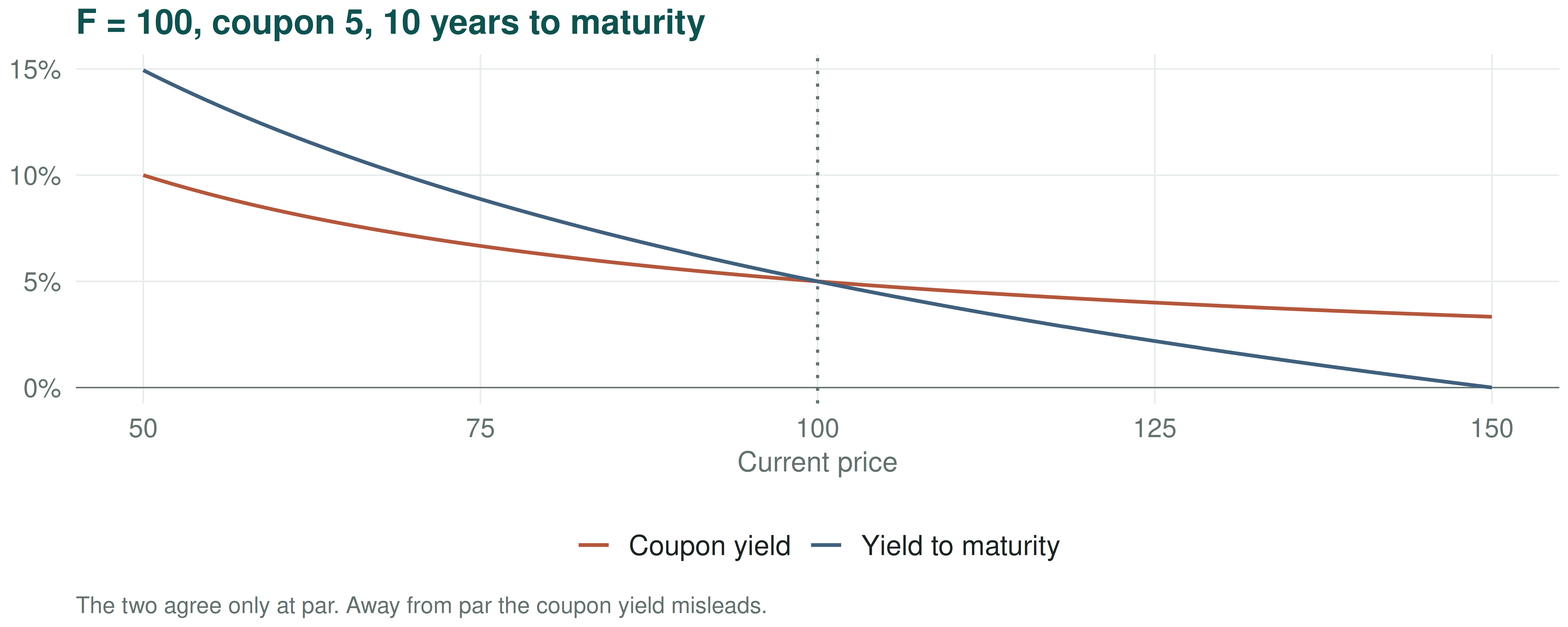
The yield to maturity is the internal rate of return r that equates the present value of the contractual payments to the observed market price:
0 = -P + \sum_{t=1}^{n}\frac{C}{(1+r)^t} + \frac{F}{(1+r)^n}
The current (coupon) yield ignores any capital gain or loss at redemption:
r_c = \frac{C}{P}
Two assumptions are embedded in the yield to maturity: that the bond is held to maturity, and that every coupon is reinvested at r. Neither holds in general, which is why realised returns differ from quoted yields.
2 · Coupon yield is only an approximation
2 · Problem 2.3
- A corporate bond yields 9%, a municipal bond 6.75%. Which do you buy?
- A corporate bond yields 5%, a municipal 3.5%, and your marginal tax rate is 28%. Which now?
2 · Problem 2.4
- What is the coupon yield on a bond with face value $1,000, current price $921.01 and a coupon rate of 10.95%?
- What is the price of a two-year, 10% coupon bond paying semi-annually, face value $1,000, if the required return is 12%?
Next session
Session 4 finishes securities markets: stocks, mortgages, foreign exchange and derivatives, then the green bonds discussion.
Bring Sartzetakis (2021) on green bonds, read — and the security your group wants to analyse. Not “a stock”. A specific one, with a ticker.
Press O for the slide overview · C to draw · S for speaker notes · F for fullscreen · E then print for a PDF of the slides.
International Finance · Session 3 · KEDGE