International Finance
Session 4 — Securities Markets: Stocks, Mortgages, Currencies and Derivatives
KEDGE Business School
October 2026
Two bonds, one required return
- What is the coupon yield on a bond with face value $1,000, current price $1,043.70 and a coupon rate of 8.25%?
- What is the price of a three-year, 6% coupon bond paying semi-annually, face value $1,000, if the required return is 8%?
- One of these trades above par and the other below. Which, and why?
Where we are
One chapter, two sessions. Last session established the money market and the bond market: the instruments, the rate conventions, and how a price and a yield are two statements of the same thing.
Today, in order:
- Stock markets — common and preferred shares, ADRs
- Mortgage markets — fixed-rate, adjustable-rate and the mortgage-backed securities built from them
- Foreign exchange — spot and forward contracts on bank deposits
- Derivatives — forwards, futures, options, swaps, credit derivatives
- Reading discussion — Sartzetakis (2021)
The same two questions apply to every market we open today: what contractual claim does the instrument represent, and what determines its price.
3 · The stock market
The residual claim
A bondholder has a contractual claim to specified payments. A shareholder owns a residual claim: whatever remains after the firm’s obligations to creditors and other senior claimants have been satisfied.
- Equity returns come from dividends and capital appreciation.
- Shareholders are residual claimants on the firm’s assets and cash flows. They also typically hold voting rights, allowing them to influence major corporate decisions.
- Because shareholders have limited liability, their payoff at liquidation cannot fall below zero, while their potential upside is unlimited.
- This payoff structure can create conflicts between shareholders and creditors, particularly over risk-taking.
- Separately, because shareholders delegate day-to-day decisions to managers, an agency problem arises: managers may pursue objectives that differ from those of shareholders.
3 · The instruments: common, preferred, foreign
Common stock — the right to vote for directors and on certain issues, and to receive dividends if the board declares them.
Preferred stock — usually no vote, but a fixed dividend paid before common. Closer to a bond than most students expect.
Foreign stocks — shares in a firm listed abroad. Useful for diversification, but awkward to buy when they are not listed locally.
- American depository receipts (ADRs) are the usual way to hold one: a bank buys the foreign shares and issues receipts against them that trade in dollars on a U.S. exchange.
3 · Where the trading happens
Organised exchanges
- NYSE trades roughly 4 to 7 billion shares a day.
- “Organised” once meant a physical floor; electronic networks have largely replaced that idea.
- Listing requirements exclude small firms.
- Auction market with floor specialists; around 25% of trades filled directly by the specialist.
Over the counter
- NASDAQ is the obvious example, with roughly 3,000 securities listed.
- Dealers stand ready to make a market — without one, the equity would be hard to trade at all.
- Multiple market makers post bid and ask prices for the same security.
Dealers quote a bid-ask spread and profit from it. Competition constrains that spread — but a spread of zero would not be sustainable either. What costs must the spread compensate the dealer for, and what happens to liquidity when those costs rise?
3 · Price-weighted versus value-weighted
An index is a measuring instrument, not an asset: one number tracking a set of securities over time. The DJIA is price-weighted across 30 stocks; the S&P 500 is value-weighted across 500.
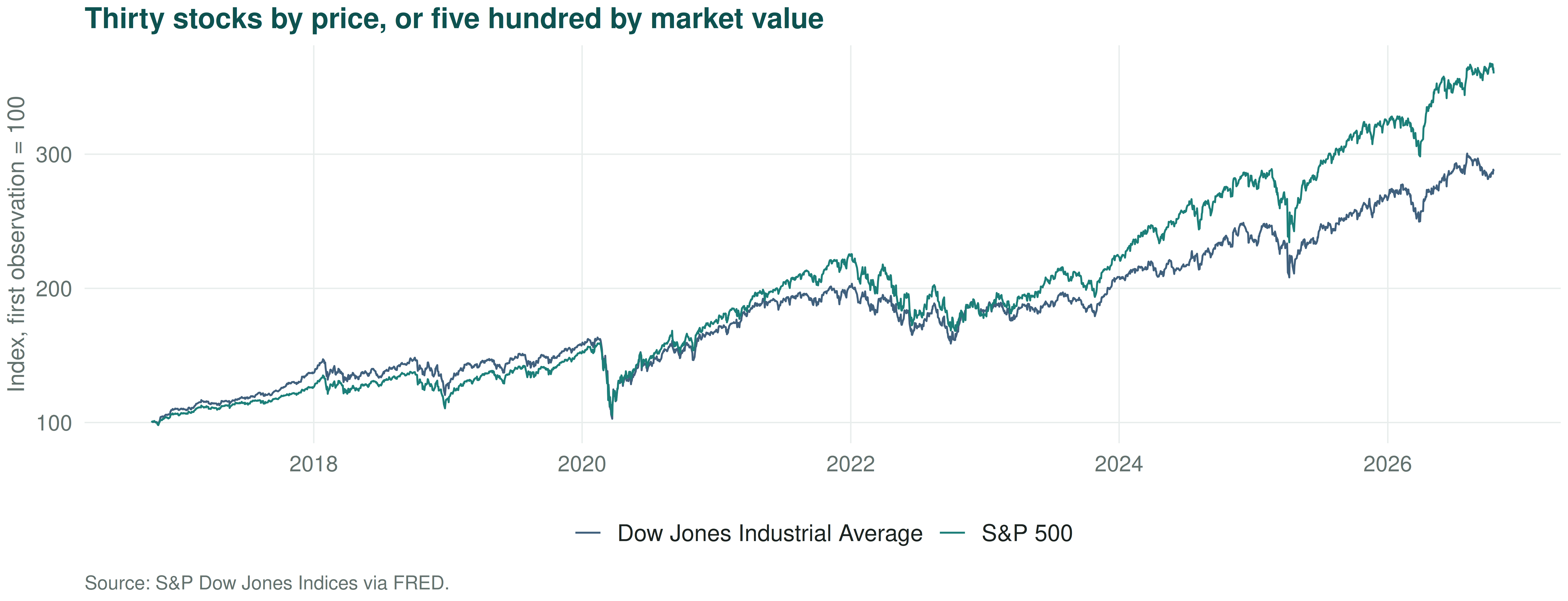
A USD 400 share moves the Dow thirteen times as much as a USD 30 one, whatever the two firms are worth. So what is the Dow measuring?
3 · What a share is worth
Three formulas, three jobs: value the share from forecasts, estimate one of the inputs, or value it without forecasting at all.
1 · Value it. The Gordon growth model — the dividend discount model with dividends growing at a constant rate g forever, and k_e > g:
P = \sum_{t=1}^{\infty}\frac{Div_t}{(1+k_e)^t} = \frac{Div_1}{k_e - g}
2 · Estimate g. Geometric growth, from two observations n periods apart:
g = \left(\frac{\text{final}}{\text{initial}}\right)^{1/n} - 1
3 · Skip the forecast. Price-to-earnings, a relative measure:
PE = \frac{\text{Price}}{\text{Earnings}}
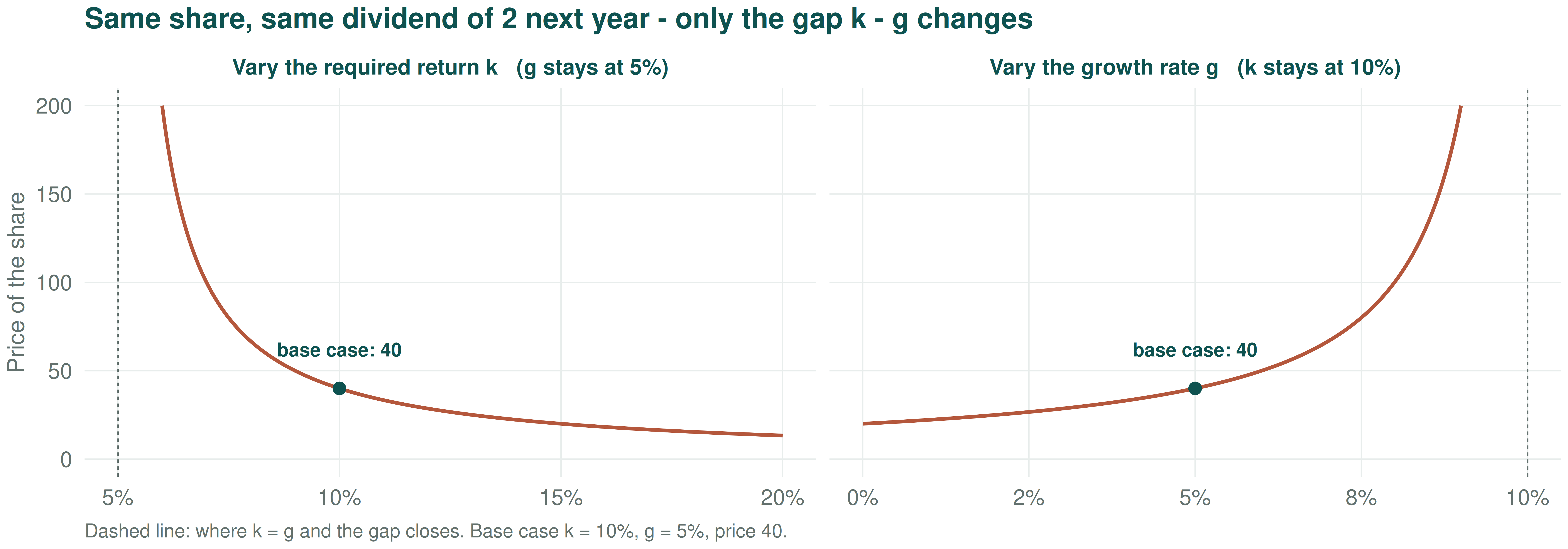
The denominator k_e - g governs everything — and it is a small difference between two uncertain numbers. As g \to k_e the price explodes, so a half-point revision moves the valuation enormously. Not a defect of the model, but a property of perpetual growth.
3 · The denominator does all the work
3 · Problem 2.5
- A stock is expected to pay a dividend of $0.16 and to be worth $60 in a year. At a 12% discount rate, what is it worth now?
- If the industry PE ratio is 16 and the firm earns $1.13 per share, what is the price?
3 · Problem 2.6
The DJIA was 10,000 in 2010 and 20,000 in 2017. What was the annual geometric growth rate?
4 · Mortgage markets
The market that ate the world
By 2006 an American mortgage was no longer a loan a bank made and held. It was an input: pooled, tranched, rated, and sold on to a German Landesbank that had never seen Ohio.
- A mortgage is a long-term loan secured by real estate.
- It is amortised: one fixed payment covers both interest and principal every month, so the balance falls to zero at maturity.
- The security interest in the property is what makes the loan cheap. It is also what links the credit market to the housing market.
4 · The instruments: eight kinds of mortgage
| Type | What it is |
|---|---|
| Conventional | Not guaranteed; usually needs private mortgage insurance and 5-20% down |
| Insured | Guaranteed by a government agency; low or zero down payment |
| Fixed-rate | The rate is fixed for the life of the mortgage |
| Adjustable-rate (ARM) | Rate tied to another security, adjusted periodically within annual limits |
| Graduated-payment (GPM) | Low initial payment rising each year; amortises in 30 years |
| Growing-equity (GEM) | Payment rises each year; amortises in less than 30 years |
| Second mortgage | Secured by a second lien; used for credit lines and home improvement |
| Reverse annuity (RAM) | The lender pays the borrower monthly; due when the property is sold |
Which of these transfer interest rate risk from the lender to the borrower, and which households tend to be sold those contracts?
4 · Securitisation, in four steps
- The secondary mortgage market was created by the federal government after the Second World War, when it set up Fannie Mae. It grew quickly from the mid-1980s.
- Individual mortgages default unpredictably, so they are pooled — hundreds at a time — on the argument that diversification tames the risk.
- Rights to the pool’s cash flows are sold as separate securities: pass-throughs, or mortgage-backed securities.
- The borrower’s monthly payment passes through a trustee before reaching the investors.
Step 2 is load-bearing. Diversification removes risk that is independent across loans. What becomes of a pool of American mortgages if house prices fall everywhere at once?
4 · Mortgage rates track long Treasuries
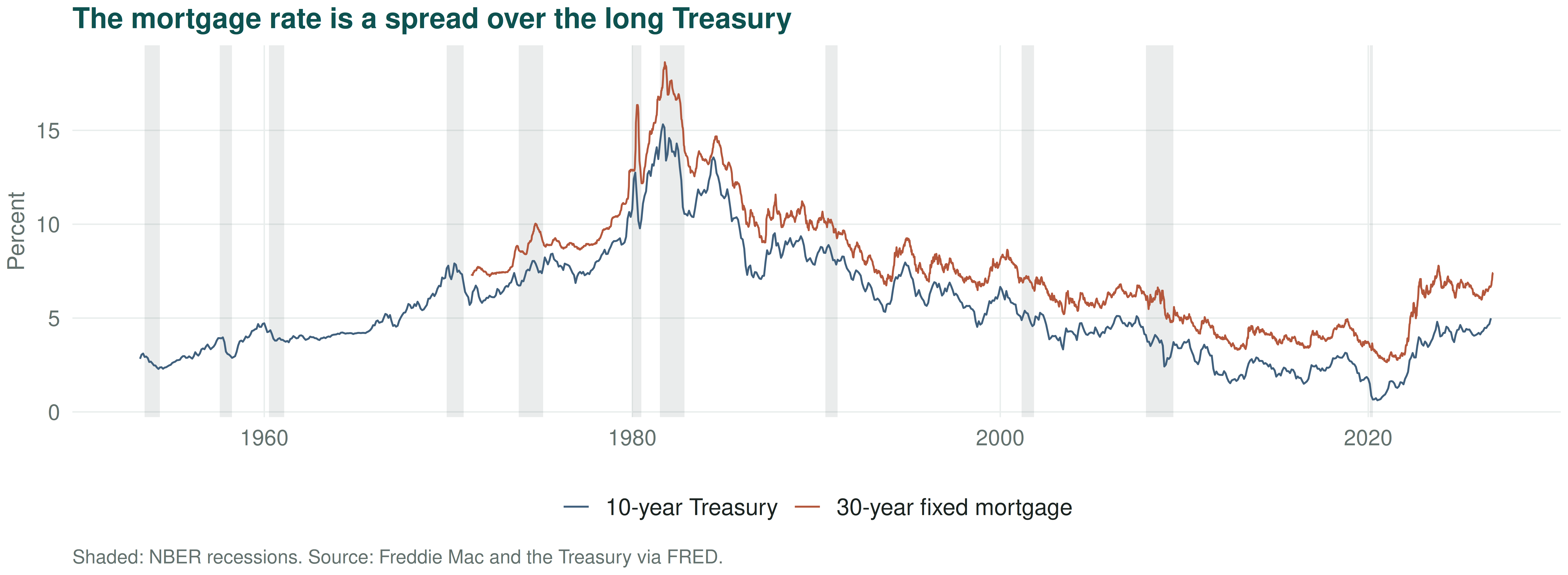
The two series move together, but the gap between them is not constant. What widens it?
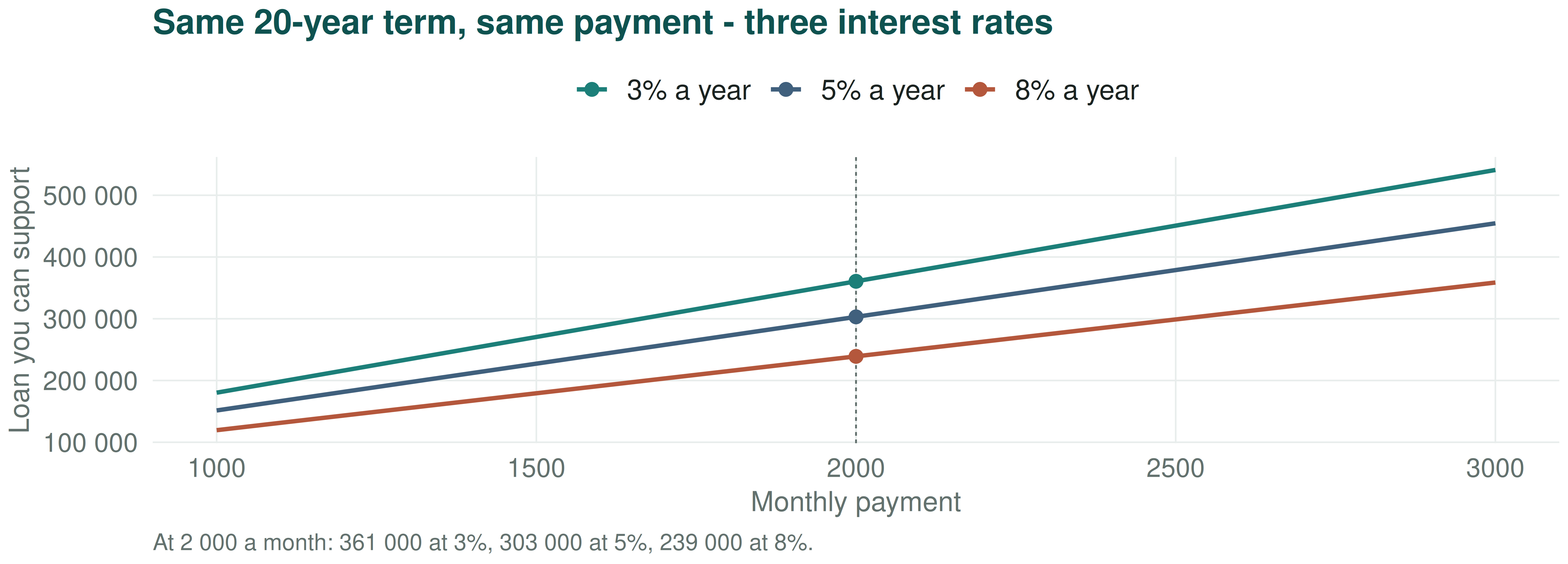
4 · Loan and annuity
What you can borrow, given what you can pay each period:
C_0 = a \times \left[\frac{1-(1+i)^{-T}}{i}\right]
What you must pay each period, given what you borrowed:
a = C_0 \times \left[\frac{i}{1-(1+i)^{-T}}\right]
4 · Problem 2.7
You want to borrow $100,000. Choose between a 12% 30-year mortgage and an 11.5% mortgage with 2 discount points. Which?
A discount point is 1% of the loan paid up front: on a $200,000 loan, 1 point costs $2,000, half a point $1,000, a quarter point $500.
4 · Getting the rate and the period right
A rate is quoted per year. Every formula in this chapter wants it per period — and the number of periods has to match. The same €150,000 loan at a quoted 6% over 25 years:
| Payments | Rate per period | Periods | Payment | Paid per year |
|---|---|---|---|---|
| Monthly | 6 ÷ 12 = 0.50% | 300 | 966.45 | 11,597 |
| Quarterly | 6 ÷ 4 = 1.50% | 100 | 2,905.59 | 11,622 |
| Semi-annual | 6 ÷ 2 = 3.00% | 50 | 5,829.82 | 11,660 |
| Annual | 6.00% | 25 | 11,734.01 | 11,734 |
Same loan, same quoted rate, four different answers. Divide the rate and multiply the periods by the same number — and never mix a monthly rate with a count of years.
4 · Problem 2.7b
You borrow €150,000 over 25 years. The quoted rate is 6% a year.
- What is the monthly payment? And the quarterly payment?
- A second lender offers 5.6% with 1.5 discount points, paid monthly. How much is the saving each month?
- How long must you keep the loan for the points to be worth buying?
5 · The foreign exchange market
The biggest market nobody sees
No building, no opening bell, no ticker on the evening news. Over the counter, bank to bank, with turnover in the trillions of dollars a day.
- What is traded is not currency in the sense of notes, but bank deposits denominated in different currencies.
- Trades are large — typically in excess of USD 1 million.
- We met the price in session 2. Now we meet the market that sets it.
5 · Purchasing power parity
Both versions rest on the law of one price: identical goods priced in a common currency should sell for the same amount, because arbitrage in goods moves the two prices together until the gap closes. PPP is that law applied to the basket rather than to the good.
- Absolute PPP — a proposition about levels. The nominal exchange rate equals the ratio of the two price levels; equivalently, the real exchange rate equals one. Requires identical baskets and frictionless trade in every good, including non-tradables.
- Relative PPP — a proposition about rates of change. The rate of depreciation equals the inflation differential, \pi_{US} - \pi_{EUR}. Requires only that frictions be constant, so they cancel in differences. This is the testable version.
- Absolute PPP is rejected in the data. Deviations are large and persistent: goods are differentiated, so firms hold pricing power, and nominal prices are sticky. Both break the arbitrage.
- What survives is a long-run proposition. Deviations decay slowly rather than not at all.
5 · The instruments: spot and forward
Spot rate — the price for near-immediate delivery of bank deposits, settling two business days forward.
Forward rate — the price, agreed today, for delivery at a fixed future date. Quoted at a premium or discount to spot, not as a forecast.
The rate is the price that clears the market for the currency, so it moves with anything that shifts demand or supply. The standard fundamentals:
- relative price levels — the PPP channel
- trade barriers — tariffs and quotas
- preferences over domestic and foreign goods
- relative productivity
Each fundamental enters as an expected change. The spot rate therefore already impounds the forecast, and moves only on news.
5 · What an appreciation does
- Domestic goods become more expensive abroad; foreign goods become cheaper at home.
- Domestic producers become less competitive in both markets.
- Domestic consumers gain purchasing power.
So is a strong currency good news? Ask a French exporter and a French holidaymaker on the same afternoon and you will get two answers.
6 · Derivative markets
A price for a promise
In 1995 Barings Bank, 233 years old, was destroyed in a matter of weeks by one trader’s position in Nikkei futures. The instruments were not exotic. The position was simply unhedged and unsupervised.
- A derivative is a contract whose value comes from the price of something else — an index, a rate, a currency, a tonne of wheat. You never own the thing itself; you own a claim written on its price.
- They exist because risk can be sold: one party wants rid of it, another will carry it for a price.
- Hedging is taking a second position that moves against a risk you already carry, so the two cancel.
- Taken on its own, that same contract is a bet. A hedge and a speculation are the same instrument — the difference is whether you already hold what it is written on.
6 · Long, short, and offsetting
A long position: you own the asset and gain if the price rises.
A short position: you do not own it — you borrow it, sell it, and gain if you can buy it back cheaper.
To hedge:
- a long position is offset by taking an additional short position
- a short position is offset by taking an additional long position
Hedging is not the absence of a position. It is two positions, chosen so that what one loses, the other gains.
6 · The instruments: five families
- An agreement between two parties to transact at a future point in time.
- Specifies the exact assets, the price, and the date of exchange.
- Long = agree to buy later. Short = agree to sell later.
- Private and bilateral, and therefore exposed to the other party defaulting.
- The same agreement as a forward — transact at a future date at a price fixed now — but on an organised exchange rather than privately.
- Standardised: the exchange fixes the contract size, the quality and the delivery dates, so contracts are interchangeable and far more liquid.
- A clearing house steps between buyer and seller and becomes the counterparty to each of them.
- Marked to market daily — the day’s gain or loss is settled every evening against posted margin, which is what removes most of the default risk.
- No delivery needed: positions are closed out and netted in cash.
- At expiry the futures price converges to the spot price of the underlying — otherwise there would be an arbitrage.
- Harder to corner, because the deliverable range of securities is wide. Regulated in the United States by the CFTC.
- The right, not the obligation, to buy (call) or sell (put) an instrument at the strike (exercise) price.
- American: exercisable at any time up to expiry. European: only on the expiry date itself.
- Written on many underlyings — stocks, stock indexes, futures, currencies and interest rates.
- To hedge you buy the contract: a put against a fall, a call against a rise. For that right you pay a premium.
- The premium is higher:
- the greater the volatility of the underlying, and the longer the time to expiry — both mean more can happen before it ends;
- for a put, and lower for a call, the higher the strike.
- An interest-rate swap exchanges one stream of interest payments for another, in the same currency.
- The plain vanilla version specifies the rates exchanged, the type of payments, and the notional amount.
- No balance-sheet change, and longer-dated than futures or options — but illiquid and exposed to default risk.
- Credit derivatives pay off on changes in credit events. The notional outstanding is in the trillions.
- Credit options are tied to ratings or spreads.
- Credit swaps exchange payments on loan portfolios, letting lenders specialise locally while diversifying.
- A credit default swap pays off, option-like, when a basket of loans defaults.
6 · Payoff profiles at expiration
- The strike (here 115) is the price written into the option: the price at which the holder may buy (call) or sell (put). The market price moves; the strike does not.
- The future is a straight line through it. The option follows that line, then goes flat at the premium — you buy the bend by giving up part of the upside.
6 · Problem 2.8
Rock Solid holds a $100 million stock portfolio that tracks the S&P 500. The manager fears a decline and wants to hedge the downside completely.
- The S&P is at 1,000. How is the hedge constructed with futures?
- What happens if a year later the index is at 900?
- And if it is at 1,100?
An index futures contract has a multiplier of 250, so one contract is worth 250 \times 1000 = \$250{,}000.
6 · Problem 2.9
The same $100 million portfolio tracking the S&P 500, the same fear, the same year ahead. The index is at 1,000, and a strike of 950 costs a premium of $200 per contract.
- How is the hedge constructed with options?
- What happens if a year later the index is at 900?
- And if it is at 1,100?
An index option contract has a multiplier of 100, so one contract is worth 100 \times 1000 = \$100{,}000.
7 · Reading discussion
Does a green label change the price?
A green bond funds an environmental project. In every other respect it is an ordinary bond from an ordinary issuer, with the same claim on the same balance sheet.
- If the cash flows and the credit risk are identical, should it trade at a different yield?
- If it should not, what exactly is the instrument for?
7 · Sartzetakis (2021), green bonds and the low-carbon transition
Choose one. One question per section of the paper, so each of you is reading a different part of it closely.
- Should the central bank’s mandate be enlarged to cover the climate transition — and if it is, who decides which sectors get cheap credit?
- Who should decide what counts as green, when the issuer writes the definition and also profits from it?
- If the issuer appoints and pays the verifier, what is an external review actually worth?
- Why should a green bond yield less than an identical conventional one — and why does the paper report a premium in §5.1 and deny one in §6?
- Does debt genuinely share the cost of the transition across generations, or does it only move the bill?
- What would have to change for the green label to bite — and is a bond the right instrument at all?
Sections: 1 → §2 · 2 → §4 · 3 → §4.1 · 4 → §5.1 and §6 · 5 → §3.1 · 6 → §5.2 and §6
Four parts, in this order, with these headings. The first three are about your question. The fourth is the same for everyone.
- The claim — what the paper argues on your question, in your own words, with the section. Not a summary of the paper. (~150 words)
- Why, and why not — the argument for it, and the strongest objection to it. This is the core. (~350 words)
- What could be done next — one concrete proposal, and who would have to act on it. (~200 words)
- And now AI — your own view. (~200 words)
Two pages maximum. Names and question number on the first line. An answer with no counter-argument is half an answer, and padding is visible.
Whatever your question, the fourth section is the same: does the rise of AI change your answer?
The paper is from 2019 and says nothing about AI. This section is not in the text and cannot be looked up. It is your own judgement, and it is the part I will read most carefully.
Start from what is actually happening now: the capital going into data centres, the electricity they need, and the claims being made about what AI will solve.
7 · Submission and marking
In your groups — maximum five. One of the six questions, one document per group.
Two pages maximum, every name on the first line.
Due 19:15.
Write it yourselves. Submissions are checked with Pangram.
| What you hand in | On the exam |
|---|---|
| Nothing | −2 |
| Something you did not really try at | −1 |
| All four sections, done properly | +2 |
| Written with AI | −1 on top |
There is no top band to compete for. Do the work properly and the two points are yours.
Next session
Session 5 moves from instruments to institutions: banks, what they do with the maturity mismatch we keep meeting, and why they are regulated differently from everyone else.
Group work: your security should be chosen by now. Not “a stock” — a specific one, with a ticker and available data.
Press O for the slide overview · C to draw · S for speaker notes · F for fullscreen · E then print for a PDF of the slides.
International Finance · Session 4 · KEDGE